

The Weight of What Singapore Throws Away
Plastic recycling Singapore’s sustainability agenda depends on is driven by a number that is hard to look away from: Singapore generates around 1.4 million tonnes of solid waste each year, and plastic accounts for a substantial share of it. The Semakau Landfill, the country’s only remaining landfill, is an engineered island off the southern coast that accepts the ash from Singapore’s waste incineration plants. Its operational life is finite. When it closes, there will be no second landfill to open. The pressure to extract more value from waste before it reaches the incinerator, and to reduce the volume of material sent there at all, is not an abstract environmental aspiration. It is a physical constraint that Singapore is running toward at measurable speed.
Why Plastic Is a Particularly Stubborn Waste Problem
Plastic recycling Singapore efforts face a material that is, by design, resistant to breakdown. The polymer chains that give plastic its strength and durability in service do not dissolve in rain or break down in soil the way paper or organic material does. A polyethylene bag buried in a landfill retains its structure for centuries. A PET bottle in a waterway breaks into progressively smaller fragments – microplastics – that enter food chains and water supplies without disappearing from the environment. The solution to plastic waste is not to find a place for it to decompose quietly. It is to recover the material before it leaves the circular economy and to put it back into production.
What Singapore’s Zero Waste Masterplan Sets Out to Achieve
Plastic waste reduction in Singapore is embedded in the Zero Waste Masterplan published by the Ministry of Sustainability and the Environment, which targets an overall national recycling rate of 70 percent by 2030 and a 30 percent reduction in waste sent to the incinerator per capita compared to 2018 levels. Plastic packaging is one of the three priority waste streams, alongside food waste and electrical and electronic waste, identified in the Resource Sustainability Act for targeted Extended Producer Responsibility schemes. Under EPR, businesses that place packaged goods on the Singapore market carry a shared responsibility for ensuring those materials are recovered at end of life.
“This generation of Singaporeans did not create the waste problem, but we are the generation that must solve it,” Minister for Sustainability and the Environment Grace Fu said when introducing the Resource Sustainability Act in Parliament.
The Recycling Pathway That Plastic Takes
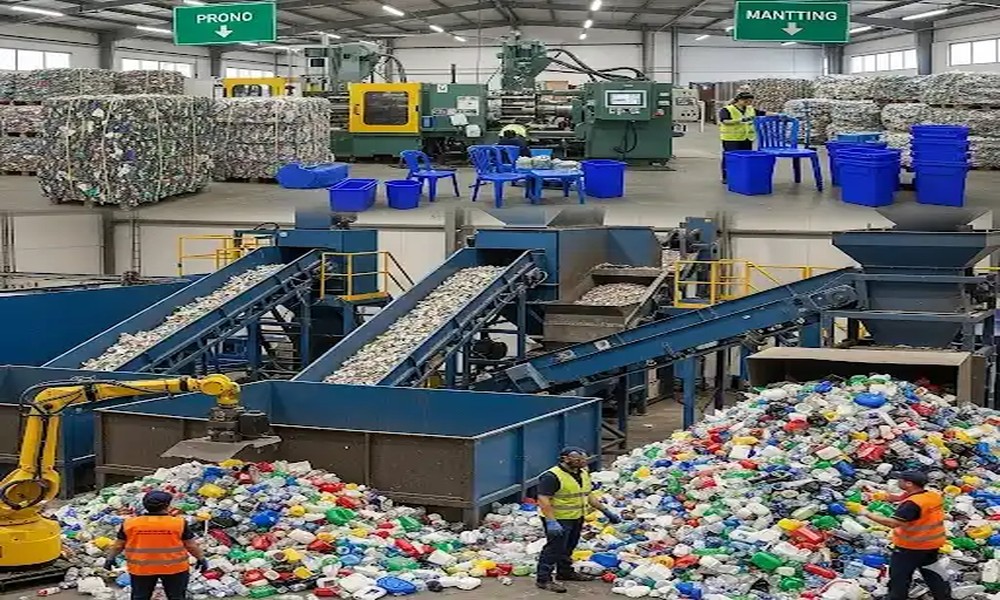
Plastic recycling Singapore processes follow a sequence that begins with collection and ends with recovered material entering a new product. Collected plastic waste is sorted by resin type, because PET, HDPE, LDPE, PP, and PVC have different melting points and cannot be processed together without degrading. Sorted plastic is shredded or granulated into flake or pellet form, washed to remove contamination, and melted down into regrind pellets that manufacturers use in place of virgin resin. The recovered material can become drainage pipes, pallet boards, geotextile fabric, or, for food-grade PET, new beverage bottles.
The yield from this process – the tonnage of recovered material that actually re-enters production – depends more on the quality of the incoming sorted plastic than on the capability of the processing equipment.
The Contamination Gap Between Collection and Recovery
Reducing plastic waste in Singapore through recycling requires confronting a gap that most sustainability reporting papers over: the difference between the weight of plastic placed in recycling collection and the weight that is actually recovered and reused. Plastic that is too contaminated to process, too mixed to sort economically, or too degraded to produce usable regrind is diverted to incineration after collection. On some recycling streams, this diversion rate is substantial. The recycling rate that a business or household reports is the collection rate, not the recovery rate, and these two figures are not the same.
Improving actual recovery means reducing contamination at the source – keeping food residue out of packaging before it goes in the bin, separating mixed polymers rather than combining them, and removing metal closures and fixtures that damage sorting equipment.
What Businesses Can Do to Close the Loop
Plastic recycling Singapore efforts are most effective when businesses engage with the full value chain rather than stopping at collection. Specifying mono-material packaging, which uses a single polymer type rather than a laminate of several, makes the packaging recyclable at end of life in a way that multi-layer film is not. Choosing packaging resins with established recovery markets, principally PET and HDPE, increases the probability that the material will actually be recovered. Working with recycling contractors who provide collection manifests and material certificates gives the business verified data on what was recovered, not just collected.
Consumer-facing businesses can extend their contribution by running take-back schemes that collect specific plastic items from customers for dedicated recycling, recovering material that would otherwise enter the general waste stream.
The Long-Term Trajectory Singapore Is Moving Toward
Singapore plastic recycling infrastructure is being expanded under the EPR framework, with industry-funded systems for plastic packaging collection and recovery supplementing municipal collection. Chemical recycling technologies, which break plastic polymers back to monomer or hydrocarbon feedstocks rather than mechanically regrinding them, are being piloted for mixed and contaminated plastics that mechanical recycling cannot handle. These technologies extend the range of plastics that can be recovered and reduce the contamination sensitivity of the recycling process.
Plastic recycling Singapore must accelerate to reduce the waste that reaches Semakau and to build the material recovery systems that a resource-constrained city-state needs for long-term sustainability.